
Das Rheingold
Background
Das Rheingold begins with a little over four minutes of a sustained E♭ major chord played by strings and horns. Some say that the opening chord is the "sound of the universe". There is an actual scientifically observed phenomenon called "baryonic acoustical oscillations" created just after the Bing Bang but still detectable today. It's theorized that these "sounds" were 47 octaves below human hearing. Nonetheless, the impact of this sustained, dark and sombre tone does achieve Wagner's prupose in signalling the emergence of the world from the nothingness from whence it came.
Not only does Das Rheingold introduce the gods, giants and dwarves, it also introduces the leitmotifs (short musical phrases) that represent these characters, places or concepts (see below for more on the leitmotifs). The characters in Das Rheingold are:
| Character | Vocal part | Role |
|---|---|---|
| Wotan | Bass-baritone | main god, think Zeus in Roman mythology, Odin in Norse |
| Fricka | Soprano | Wotan's wife, goddess of marriage |
| Freya | Soprano | Fricka's sister, goddess of youth and beauty |
| Loge | Tenor | Demi-god of fire, advisor to Wotan |
| Donner | Baritone | God of thunder |
| Froh | Tenor | God of spring and happiness |
| Wogelinde | Soprano | Rhine maiden |
| Wellgunde | Soprano | Rhine maiden |
| Flosshilde | Mezzo | Rhine maiden |
| Fafner | Bass | Giant, older of the two |
| Fasolt | Bass-baritone | Giant, younger of the two |
| Alberich | Bass-baritone | Dwarf who steals the Rhine gold |
| Mime | Tenor | Dwarf, brother of Alberich, master metal worker |
| Erda | Contralto | Goddess of Earth itself, knower of all: past, present, and future |
Wagner's musical concepts were so strongly set in his sound world that he commissioned the creation of a new instrument to fill the tonal range needed for the Valhalla leitmotif. This horn, called the Wagner horn, is positioned between a tuba and a french horn.
Wagner was a deeply flawed individual and wrestled with many demons, but he was obviously self-aware as well. He wrote himself or his psychoses into many of his characters. It's possible to argue that all his operatic characters are parts - large or small - of him. For example, the name of the dwarf who kicks it all off: "Alb"="elf" , "er"="he", "ich"="I". He is also certainly Wotan, Fafner, Fasolt, Donner and Froh (as well as most of the other characters in his other operas).
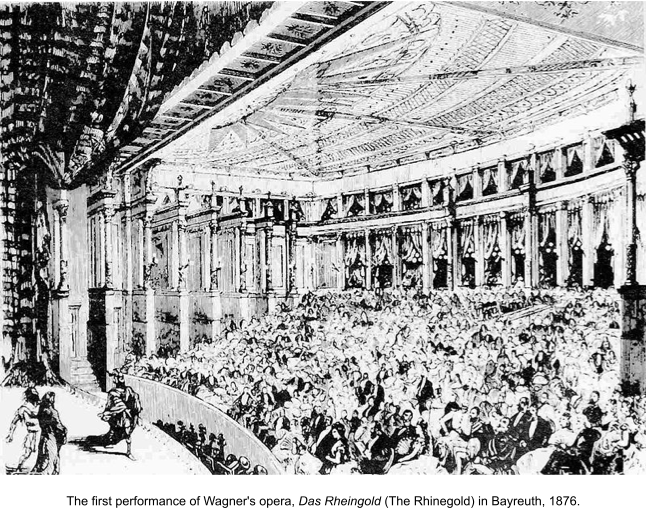
Wagner was a megalomaniac and wanted to re-create - at least the musical world - to his liking. His concept of opera was called gesamtkunstwerk (making use of all art forms). He wanted the artwork, music, costumes, performers to all be specifically designed or chosen to represent his work. To this end, he designed his own venue, Bayreuth, for his music festival at which he premiered Das Rheingold and the rest of his works. (This was also done because he couldn't get bookings in Paris, the then centre of the opera world.) But we owe to Wagner innovations that are with us still. His attention to acoustics led to the below seating level orchestra pit. Before Wagner, musicians were either on the stage or just in front of it. Many smaller European venues are still simply salons all at one level. If you're lucky a portable 6-inch "stage" will be set to place the orchestra, but most audience members in the salon don't actually see the orchstra during the performance - only the back of heads in front of them. Wagner also turned the conductor's back to the audience.
Short Synopsis
Please refer to the synopsis item below for a fuller synopsis. The story is about a dwarf who steals gold after learning of it's mystical power if he forges it into a ring. Meanwhile, Wotan, the main god has engaged two giants to build a new home for the gods, Valhalla, at the urging of h is wife. When the giants finish they want their payment - Freya. But Wotan had intended to alter the agreement and with Loge's help hears about the Rhine gold stolen by Alberich. Wotan and Loge descend to the dwarves' realm and steal the gold and kidnap Alberich. They present the gold to the giants who had agreed on the alteration to the contract. Wotan had wanted to keep the powerful ring, but the giants insist upon it to fulfill the agreement. Erda arises to convince Wotan to let go of the ring, foretelling woe to its posessor. The giants fight over the gold and one is killed. The other one takes the gold away and the gods take possession of Valhalla.
At the end of the fourth opera, Gotterdammerung, Valhalla burns and the gods are destroyed as a result of the ring being returned to the Rhine maidens.
Okay, enough! More words are written and published about Wagner and his works than about all other musicians and their works combined. Now, on to practical information.
Our Showing - 2 hrs, 23 mins
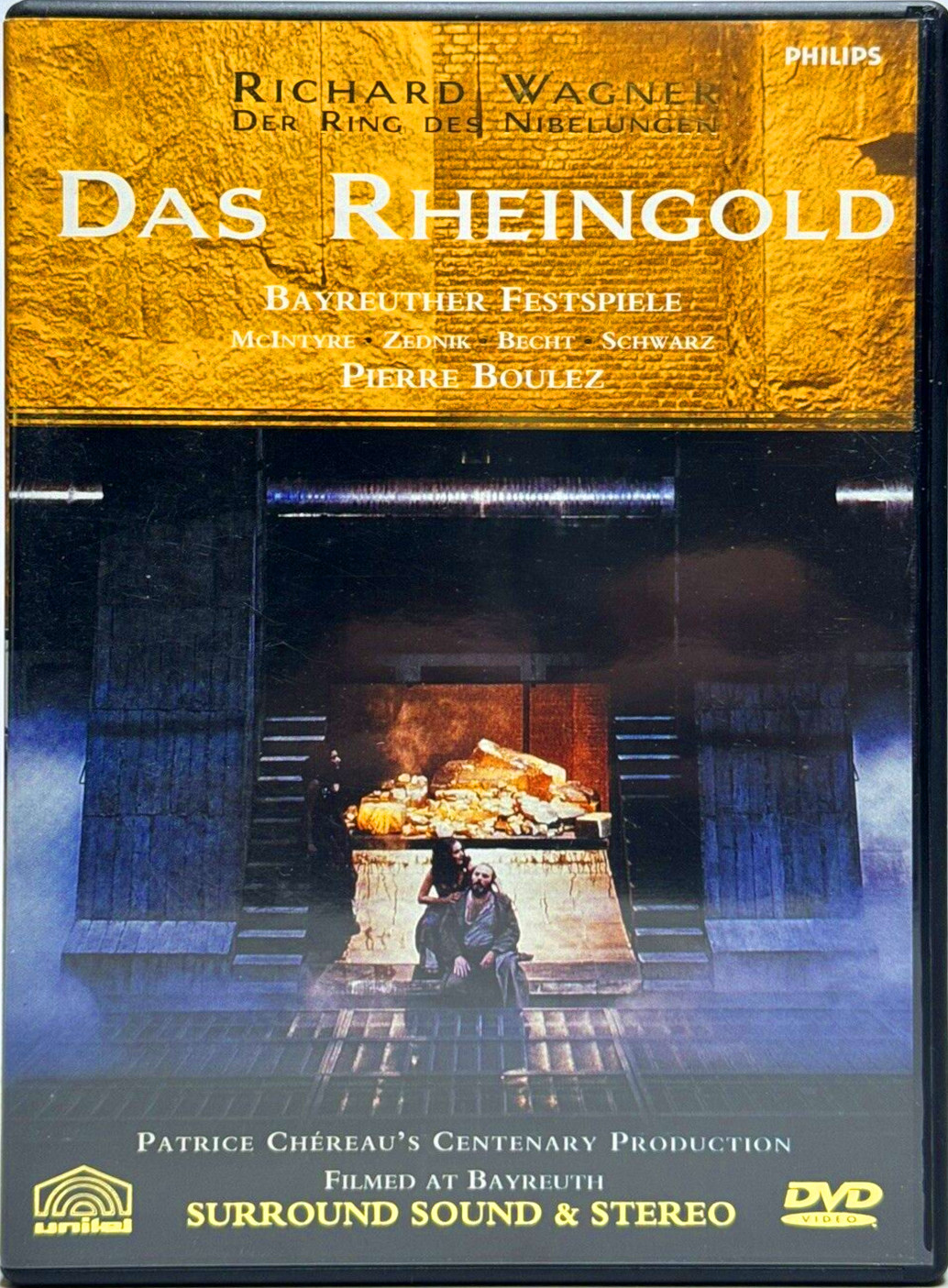
This is from the famous Pierre Boulez production of the Ring Cycle in Bayreuth in 1976. It was called the "Ring of the Century" primarily because it was presented on the centenial of the inaugural Bayreuth Festival. It was not without controversy due to the setting in a modern industrial dam. The matter of importance is that the staging and acting help tell the story very well. It's a great version to get started with. More about Das Rheingold ...
Das Rheingold is the opening opera of the 4 opera Ring Cycle. Counter-intuitively, it was the last to be written. Wagner's initial goal was to write an opera about the hero, Seigfried. But after he wrote it he realized it needed some setup, so he wrote Walkure to introduce Seigmund, the progenitor of Siegfried. After that, he realized that a finale to the hero's story arc was needed and so he wrote Götterdämmerung. Finally, he thought it would be a good ideal to justify the cause of the story and introduce the characters. Thus, Rheingold sets up the rest of the Ring Cycle.
Musically, it's a bit different as well. Rheingold has more "recitative" than actual singing, and that's because the purpose of this part of the cycle is to explain what's going on and why. So, while you won't find a stunning stand-alone aria that can be sung in isolation by a sequined diva in a greatest hits concert setting (you won't find that among any of Wagner's work), it is still a beautiful work of art that will ground the viewer in the motivations of the characters in what is the most monumental achievement in the operatic sphere.
Synopsis
Elaborate synopsis for Das Rheingold.
Libretto
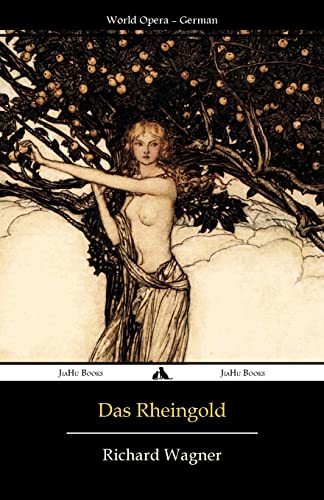
Libretto in English on the left and German on the right.
Leitmotifs
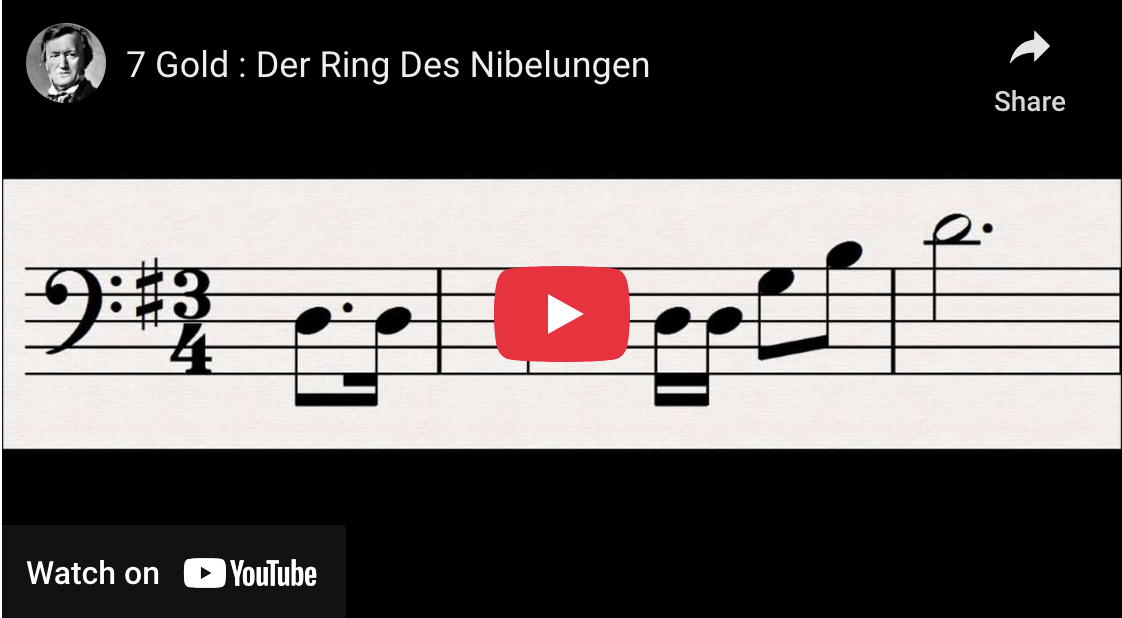
An article discussing the leitmotifs in Das Rheingold.